Statue of Maraprabhu
A 52-foot Lord Hanuman, sculpted not from stone or bronze but from terracotta and medicinal herbal clay — a one-of-its-kind devotional monument near Guruvayur.
Timings
9:00 AM – 5:00 PM
Open all days
Distance
3 km, near Punnathur Kotta
Height
52 feet (16 m)
Material
Terracotta + herbal clay
A 52-foot tribute in living clay
Just three kilometres from the Guruvayur Sri Krishna Temple, in the same green tract that holds the famous Punnathur Kotta elephant sanctuary, stands one of the most extraordinary devotional monuments in Kerala — the Statue of Maraprabhu. Towering 52 feet (about 16 metres) above the surrounding paddy fields, the colossal Lord Hanuman strikes a heroic pose: chest puffed, mace in hand, gaze lifted toward the eastern horizon where Sri Rama is imagined to stand. What makes this statue truly singular, however, is not its size but its substance. It is built entirely from terracotta and a special clay mixed with medicinal herbs and tree saps — earning it the name Maraprabhu, "the Tree-Lord" in Malayalam.
The conception is unusual for a region whose monumental religious art has historically favoured granite, laterite or bronze. By choosing clay, the artists were making a deliberate statement: that even the most heroic deity can be raised from the simplest, most local materials — earth, water, herbs — provided they are bound by devotion. Visitors who stand at the foot of the statue often remark on how warm and alive the surface feels compared to stone, especially at sunrise when the morning light catches the terracotta-red curves of Hanuman\'s muscular torso.
The story behind the build
The Maraprabhu project was initiated in the early 2000s by sculptor and ritual-design specialist Sreekumar of Guruvayur, working alongside a team of traditional kalari-trained clay artisans. The internal armature is made of reinforced rods, but the entire outer skin — every fold of the loincloth, every curl of the tail, every detail of the bracelet on Hanuman\'s arm — is hand-modelled in marunnu clay. Because the medium is organic, the statue undergoes a periodic ritual re-coating every few years, treated almost like a living temple deity. This punaruddharanam ceremony attracts devotees and art lovers alike.
Why visit Maraprabhu
- Spiritual significance — Hanuman is the patron of strength, courage and freedom from obstacles. Reciting the Hanuman Chalisa at the foot of the statue is a popular ritual.
- Artistic significance — A rare example of large-scale Indian clay sculpture; an inspiration to contemporary Indian artists rediscovering terracotta.
- Photographic appeal — Best photographed at sunrise (warm red light on the eastern face) or sunset (silhouette against the western sky).
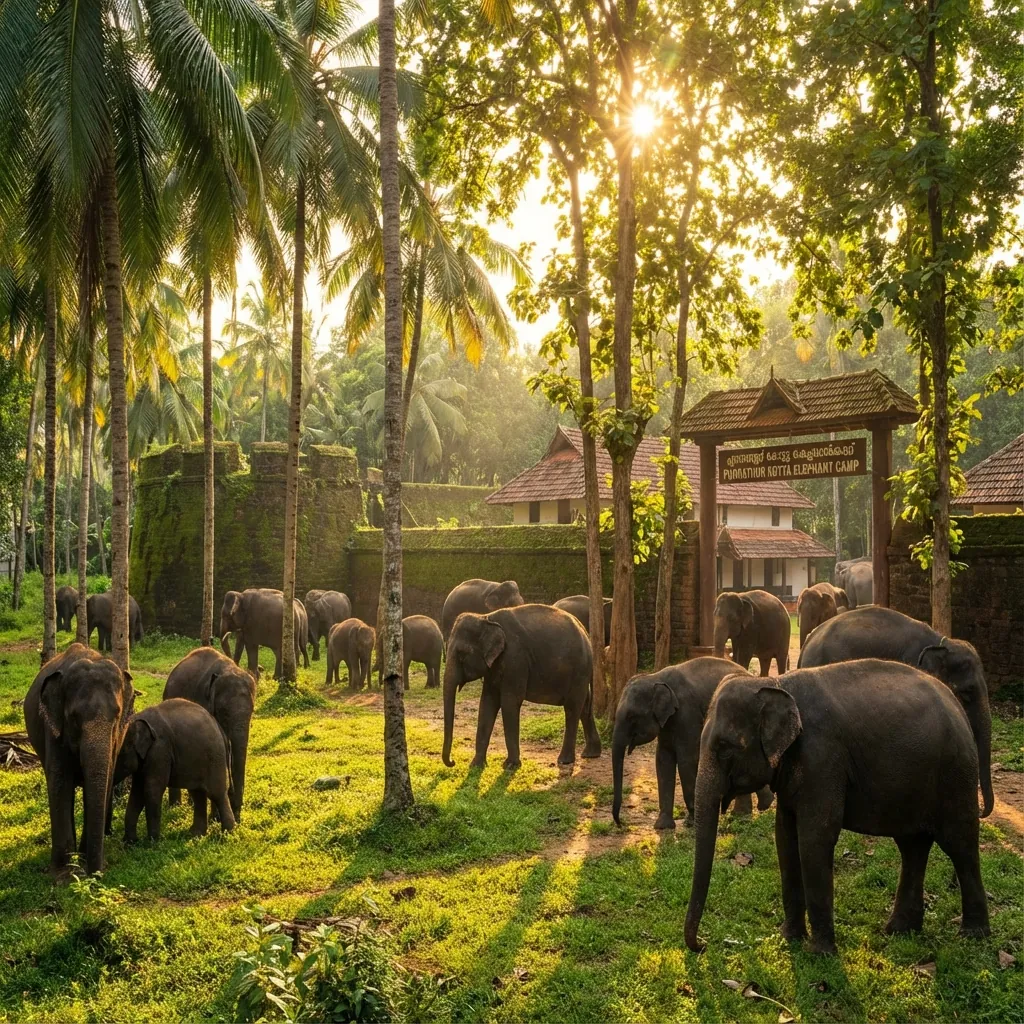
- Family-friendly — Combines beautifully with a visit to the elephants at Punnathur Kotta next door — children love both.
How to reach
- By auto-rickshaw from Guruvayur Temple — ₹100-₹150 for a one-way trip, ₹250-₹350 with waiting time so you can also visit Punnathur Kotta.
- By taxi — ₹500-₹700 round trip for a small car, ideal if you are travelling as a family.
- By car — Take the Guruvayur-Kottapady road, follow signs to "Punnathur Kotta / Anakkotta". Free roadside parking.
- By bus — Local KSRTC and private buses on the Guruvayur-Kottapady route stop within walking distance.
A suggested half-day circuit
The best way to experience Maraprabhu is to fold it into a half-day temple-town circuit:
- 5:00 AM — Nirmalya darshan at the main Guruvayur temple.
- 8:00 AM — Breakfast at a Devaswom-run hotel.
- 9:00 AM — Auto-rickshaw to Punnathur Kotta. Spend an hour with the elephants.
- 10:30 AM — Walk or short ride to the Statue of Maraprabhu. Spend 30-45 minutes.
- 11:30 AM — Return for a quick stop at the Institute of Mural Painting.
- 12:30 PM — Lunch (Devaswom annadanam if you are eligible, or a local sadya).
Tips
- Carry a hat or umbrella; the platform area is fully open to the sun.
- Drones are not permitted. Tripods are fine.
- Avoid climbing onto the statue\'s base — devotees come here for quiet prayer.
- A small donation in the temple kanikka box helps maintenance of the statue.
Frequently asked questions
How tall is the Maraprabhu statue and what is it made of?
The statue stands roughly 52 feet (16 metres) tall, making it among the largest depictions of Lord Hanuman in Kerala. Unusually, it is not made of stone, bronze or concrete — the entire form is built up from terracotta and a clay mixed with traditional medicinal herbs (called marunnu in Malayalam), giving it the name "Maraprabhu" (the Tree-Lord).
Who created the Maraprabhu statue?
The statue was conceived and built by celebrated Kerala sculptor and ritual designer Bharath Kalakshetra master Sreekumar of Guruvayur, in collaboration with traditional clay artisans. It was inaugurated in the early 2000s and continues to receive periodic re-coating of the herbal clay to preserve its structural integrity.
Is the statue inside Punnathur Kotta?
The statue stands in the same broader complex area as the Punnathur Kotta elephant sanctuary (Anakkotta), about 3 km from the main Guruvayur temple. Many visitors combine both attractions in a single trip — entry to the statue site is free, while Punnathur Kotta has a small entry ticket.
Why is Hanuman worshipped at Guruvayur?
Although Guruvayur is primarily a Krishna shrine, Hanuman has a deep cultural connection here. The Devaswom's elephant sanctuary, Anakkotta, is named after the divine elephants gifted to the temple, and Hanuman is venerated as the patron deity of strength and devotion. Devotees from across India offer prayers at Maraprabhu for vigour, courage and freedom from obstacles.
Is photography allowed at the Maraprabhu site?
Yes — photography of the statue itself is freely permitted. Drones, however, are not allowed. Please be respectful of devotees praying nearby and avoid climbing on the platform.